What to Bring to a DUI Lawyer Consultation: Documents and Details That Help Your Case Move Faster
Gather all the paperwork you received at release and afterward—your Express Consent paperwork/notice (often yellow in breath-test or refusal cases), your citation with the court date, and any bond conditions. Write down what happened: where the stop occurred, what time, what the officer said, which tests you performed. If you have prior DUIs, bring the dates and locations. If you hold a CDL or your job requires driving, have that information ready.
The more prepared you are, the more we can cover in that first meeting. I can review your Express Consent timeline, flag issues with the stop, and if you decide to move forward with representation, file the DMV hearing request promptly. Without the paperwork, we may spend valuable time tracking it down while deadlines keep moving. The consultation is free and confidential, and being prepared helps us use that time well—especially with DMV deadlines.
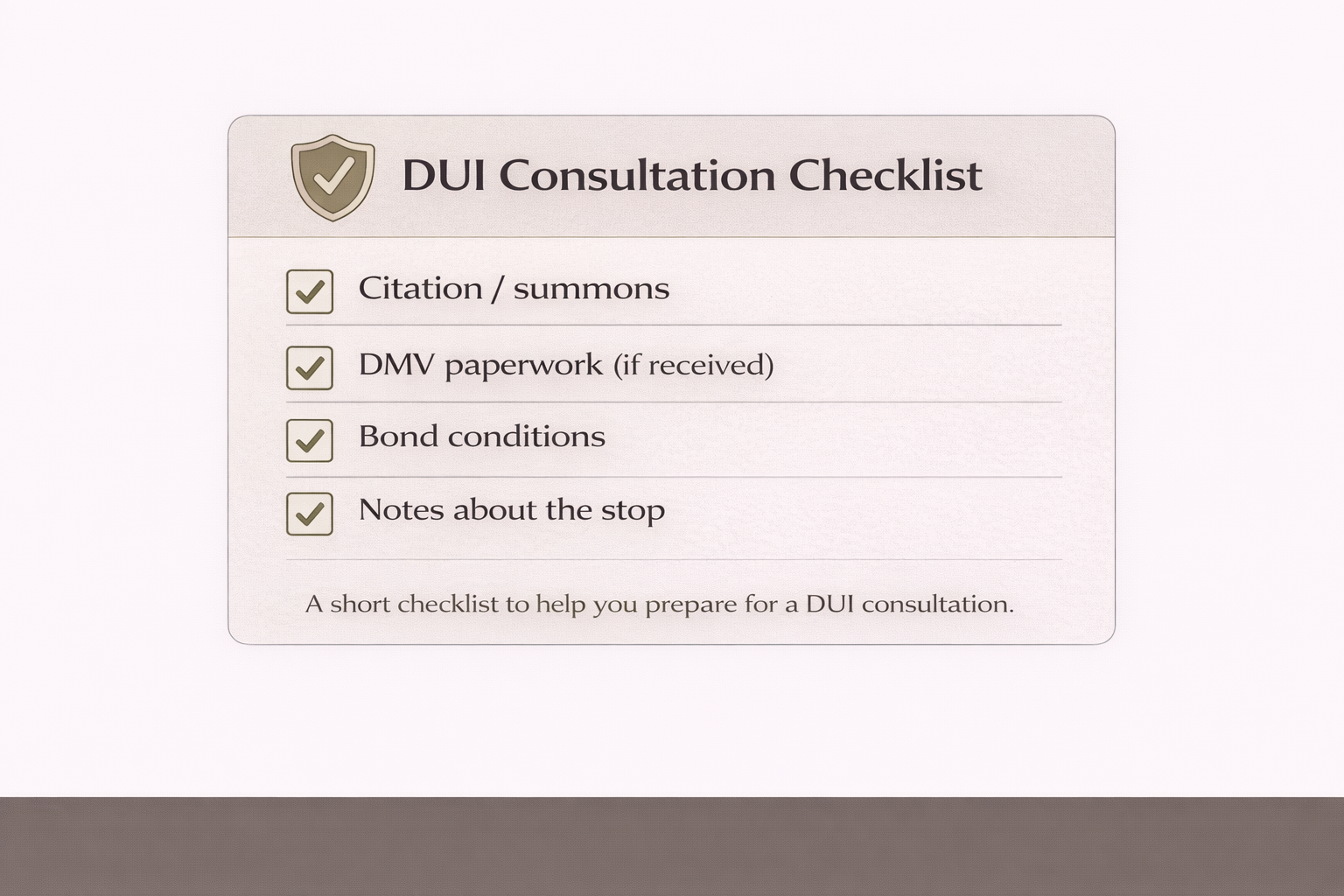
Every Document from Your Arrest
You may receive several documents when you're released—and in blood-draw cases, some DMV notices often arrive later by mail. Find all of them. If anything arrives later by mail from DMV, bring that too.
Essential documents:
Express Consent paperwork/Notice (often yellow in breath/refusal cases) — This identifies whether the case involved a breath test, blood draw, or refusal and includes hearing instructions and time-sensitive deadlines. In many breath/refusal cases it also functions as a temporary permit.
Citation — Lists your court date, case number, and the charges. Bring it so we can calendar dates and confirm what's been filed.
Bond conditions sheet — If the court sets any conditions for your release, have that paperwork. Bond conditions might include no-contact orders, alcohol restrictions, or check-in requirements.
Any other receipts or paperwork — Include anything else you received that night: property receipts, towing information, bail paperwork, or written instructions from the officer or jail staff.
If you cannot find one of these documents, tell me during the consultation. I can request copies from the court or police department, but that takes time. The sooner I have the original documents, the faster I can act on your deadlines.
Written Details About the Stop
Write down what you remember about the stop—details fade quickly, and specifics matter for your defense.
Details to document:
Exact location of the stop — Note the street names, cross streets, landmarks, or mile markers. "Somewhere on Main Avenue" is not specific enough. "Main Avenue and 9th Street, southbound" helps me locate security cameras and witnesses.
Time of the stop — Note the approximate time the officer turned on their lights.
Reason for the stop — Document what the officer said when they pulled you over: broken taillight, speeding, lane violation. Include their exact words if you remember them.
Everything the officer said to you — Note if they asked where you were coming from, if they said they smelled alcohol, if they commented on your speech or eyes.
Field sobriety tests performed — Record which tests the officer asked you to do, how each one went, the surface you were on (uneven, gravel, ice, wet pavement), and weather conditions (temperature, rain, snow, wind, cold).
Chemical test details — Document if you took a breath test at the station, blood test, or refused testing. If you took a test and remember the result the officer mentioned, include that.
Your physical state — Note if you were tired, sick, on medications, injured, or nervous. Include anything that could have affected your balance or speech.
Witnesses — Record if there were passengers in your car, other drivers nearby, or pedestrians. Get their names and contact information if possible.
Have this written summary ready. I use these details to evaluate possible constitutional issues, assess probable cause, and map out a defense strategy.
Your Personal Information and Circumstances
Information I need to know:
Prior DUI or alcohol-related convictions — If you have priors in Colorado or another state, bring the dates and locations. Prior history can change what penalties are on the table under Colorado law, so it's important to identify it early. Some repeat offenses carry mandatory minimums.
Commercial Driver's License (CDL) — If you hold a CDL, your DUI has additional consequences beyond losing your regular driver's license. Federal regulations impose stricter standards for commercial drivers. Have your CDL information and any details about your employer's requirements ready.
Job requires driving — If your job requires you to drive (delivery driver, sales, home healthcare, ride-share, etc.), include that information. License restrictions can affect your ability to work, and I need to know that when planning your defense and DMV strategy.
Out-of-state license — If you hold a driver's license from another state, have that information ready. Your home state will be notified of the Colorado DUI, and they may impose their own penalties.
Medications — If you take prescription medications that could affect field sobriety tests or chemical testing, list those medications and dosages. Some medications cause symptoms that officers mistake for intoxication.
Medical conditions — Document any medical conditions that affect balance, coordination, speech, or eye movement. Inner ear problems, neurological conditions, knee or ankle injuries, or diabetes can all impact field sobriety test performance.
Your Questions Written Down
Write your questions down so you don't forget them when we're talking. Common questions:
What are the possible penalties for my charges?
Will I lose my license, and for how long?
Can I get a restricted license to drive to work?
What is the DMV hearing, and how is it different from court?
Do I have to go to jail if convicted?
How much will this cost in total?
How long does a DUI case take in Colorado?
Should I plead guilty or fight the charges?
What defenses apply to my case?
What happens at my arraignment?
Learn more about how DUI defense in Colorado works.
What Happens at the Consultation
First, we confirm your Express Consent timeline and whether a hearing request is still available. If you're within the deadline and you choose to retain counsel, the DMV hearing request can be submitted promptly. I review your stop details—looking for probable cause problems, improper field sobriety procedures, or testing errors that could support motions to suppress evidence.
Based on what you provide, I explain which defenses apply, what to expect at arraignment, and how we handle both the DMV hearing and criminal court simultaneously.
My background: almost eight years as a Deputy then Senior Deputy Public Defender in Southwest Colorado, handling high volumes of DUI cases in the 22nd and 6th Judicial Districts. I know these courts, these prosecutors, and what works. Learn more about my experience.
If you have been arrested for DUI in Durango, Cortez, Pagosa Springs, or anywhere in Southwest Colorado, contact NewbergerKing Law to schedule your free consultation. Come with your paperwork and be ready to talk about what happened.