DMV vs Criminal Court After a Colorado DUI: Two Separate Processes, Two Timelines
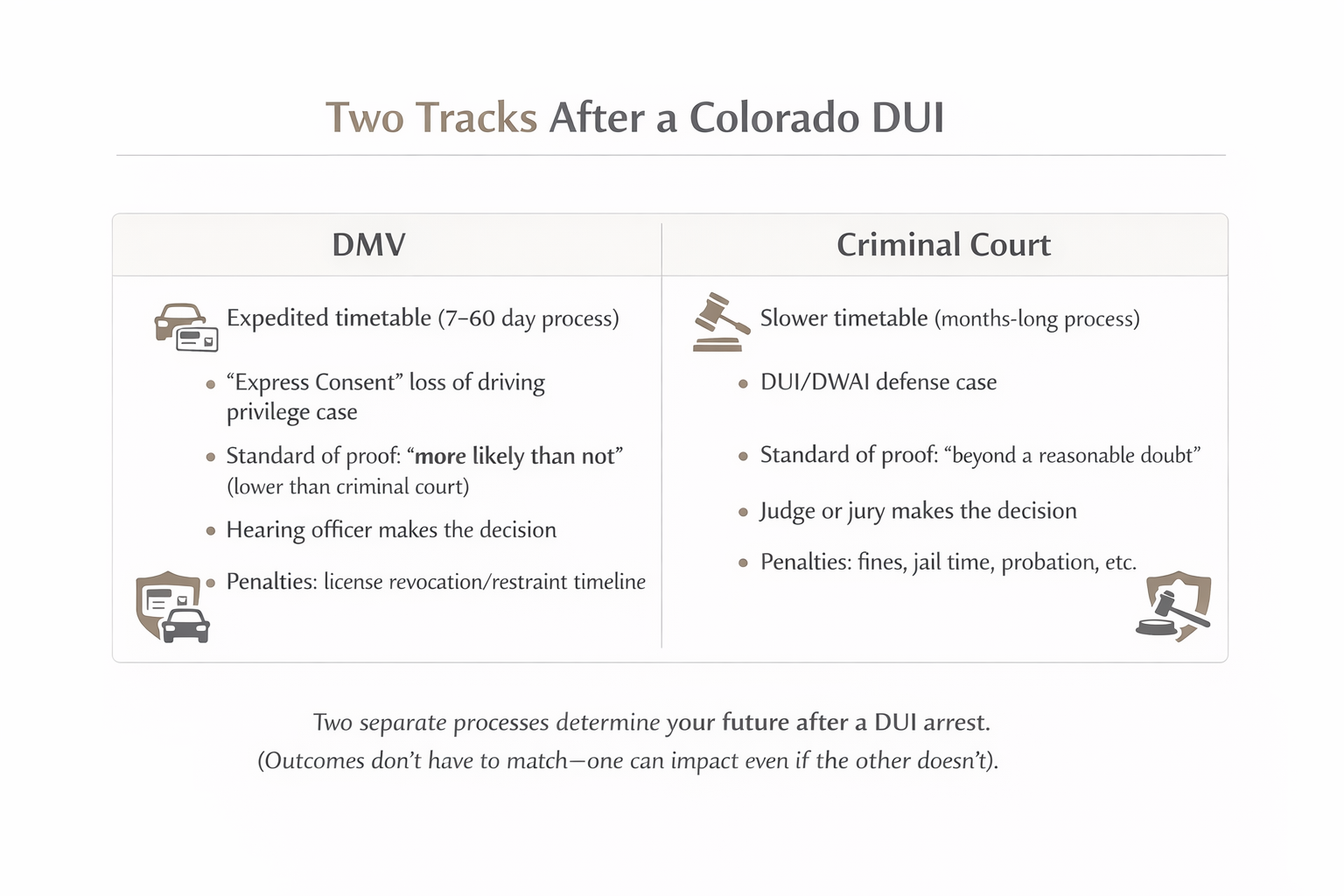
Your DUI arrest triggers two separate cases the same night: one through DMV that decides if you keep your license, and one through criminal court that decides if you're guilty. They run on parallel tracks with different deadlines, different standards of proof, and different outcomes. It’s possible for the outcomes to differ between the two tracks.
In breath-test or refusal cases, you’re typically served Express Consent paperwork at the stop. In blood-test cases, DMV typically mails the Notice of Revocation later, after results are processed.
The DMV Process: What It Decides and When
The DMV case is administrative, not criminal. It does not decide guilt—it decides whether you keep your driving privileges.
Timeline:
Breath test or refusal: Served Express Consent Affidavit/Notice at arrest. You have up to 7 days from the arrest to request a hearing.
Blood test: DMV mails a Notice of Revocation after results are processed. You have up to 7 days after you receive it to request a hearing.
Hearing timing: Hearings must be held within 60 days of the original request (timing can vary).
The hearing officer works for the Department of Revenue, not a judge. They review the officer's affidavit, your test results, and whether proper procedures were followed. Standard of proof: preponderance of evidence, which means "more likely than not." That's lower than criminal court.
If the DMV action is sustained, the license restraint (or revocation) period depends on the scenario. In many adult test-result cases (BAC .08+), it’s commonly 9 months on a first Express Consent action, 12 months on a second, and 24 months on a third. Refusal cases can carry longer restraint periods, and eligibility for early reinstatement or limited driving often depends on the category and mandatory no-driving period.
The Criminal Process: What It Decides and When
Criminal court determines guilt or innocence for the DUI charge. The District Attorney files charges—DUI, DWAI (Driving While Ability Impaired), or both—and you're summoned for arraignment. That's your first court appearance, usually three to four weeks after arrest.
Timeline:
Week 3-4: Arraignment (first appearance, enter plea)
Month 2-6: Pretrial hearings, motions, discovery
Month 6-12+: Trial (if no plea agreement)
Post-trial: Sentencing if convicted
At arraignment, the judge advises you of charges and sets bond conditions. You plead not guilty if you're fighting it, and the case moves to pretrial. That's where I review all evidence—police reports, dash cam footage, test results, witness statements. I file suppression motions if the stop was illegal or testing was done improperly.
Most cases resolve during pretrial through negotiation or dismissal. Some go to trial. Criminal court uses "beyond a reasonable doubt" as the standard—much higher than DMV's standard. A jury or judge decides, not a hearing officer.
Penalties if convicted: jail time (mandatory minimums for repeat offenses), fines, probation, alcohol classes, community service, license suspension separate from DMV's revocation.
How the DMV and Criminal Court Decisions Fit Together
After a Colorado DUI, you’re dealing with two separate tracks at the same time:
DMV (Express Consent): decides what happens to your driving privileges.
Criminal court: decides what happens with the DUI charge (guilt/penalties).
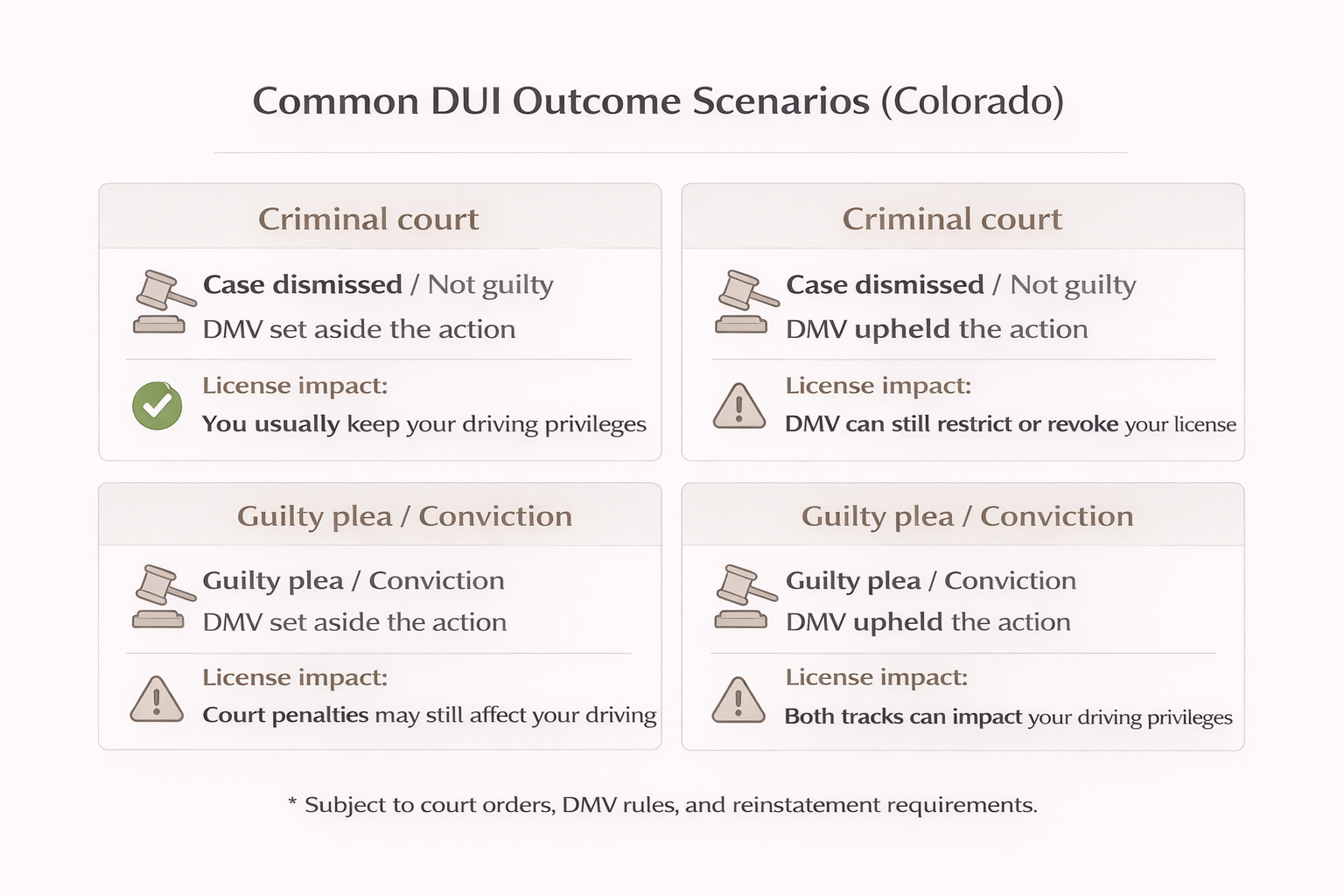
Because they decide different things and use different standards, the outcomes don’t always “match.” That’s normal.
Why this happens
DMV only needs to show it’s more likely than not that the Express Consent requirements were met. Criminal court has to prove the DUI charge beyond a reasonable doubt, which is a much higher bar.
Bottom line: you can’t ignore either track—DMV moves fast, criminal court moves slower, and both matter.
Two Timelines Running Simultaneously
DMV moves fast. Request your hearing within the deadline, and DMV is required to hold the hearing within 60 days of your request (scheduling can vary). Decision comes shortly after. DMV outcomes often happen relatively early—sometimes within a couple of months—while the criminal case is still in its early stages.
Criminal court moves slowly. Arraignment at week three or four. Pretrial hearings over the next several months. Trial scheduled six months to a year out, sometimes longer if the case is complex or the court calendar is full. Total time from arrest to trial: typically one year, sometimes more.
What this means practically:
Your DMV case resolves while your criminal case is still in pretrial. If you lose the DMV hearing, your license revokes months before you ever get to criminal trial. You're driving on an ignition interlock device (if you qualify for early reinstatement) or not driving at all while fighting criminal charges.
If you win the DMV hearing, you keep driving with your regular license while the criminal case proceeds. But if you later lose the criminal case, the court can impose its own license suspension on top of whatever DMV already decided.
The timelines don't pause for each other. Criminal court doesn't wait for DMV. DMV doesn't wait for criminal court. Both cases demand attention simultaneously, and missing deadlines in either one has consequences the other case can't fix.
Handling Both Cases From Day One
Evidence overlaps between both cases. The officer's affidavit from the DMV hearing becomes part of criminal discovery. What they say under oath at the DMV hearing can impeach them later if their story changes at trial. Handling these processes separately means missing those connections.
Both deadlines started the night you were arrested. For a free consultation, call NewbergerKing Law at (970) 946-4157.